
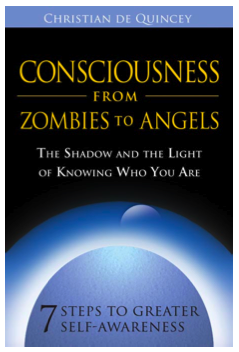
Consciousness from Zombies to Angels

New WisdomBlog
Click here for frequent updates on
consciousness.

Consciousness
—
from —
Zombies
to
Angels
An
Interview with Christian de Quincey, Ph.D.
Q: What will people learn from
Consciousness from Zombies to
Angels?
CdeQ:
Readers will
join me on the greatest adventure of all:
an
exploration of philosophy’s hardest problem,
science’s final frontier, and
spirituality’s deepest mystery. They will find
seven simple steps on the path to knowing who they
truly are.
I'm a
professor of Consciousness Studies at John F. Kennedy
University and Dean of Consciousness Studies at the
University of Philosophical Research. I've been
teaching and writing about consciousness for decades.
It's my life-long passion.
I wanted to create a comprehensive, easy-to-understand
“user’s guide” to to the
mind—exploring the full spectrum of consciousness
from philosophy through science to spirituality. This
book is based on presentations and handouts I created
over the years for my students to inform and inspire
them about the nature and possibilities of our most
intimate reality—consciousness.
Q:
How did you come up with the title?
CdeQ: Originally,
I wanted to write a kind of Consciousness
for
Dummies book—like
Meditation
for Dummies, Yoga for Dummies, Philosophy for
Dummies, etc. But I
wanted to call it Consciousness
for Zombies. You see, in
philosophy, a “zombie” is a very special
kind of creature: It is just like a human in every
way, except
it has no mind or consciousness whatsoever.
Then (after
prompting from my publisher), I realized that probably
only philosophers would get the pun. So I went to Plan
B.
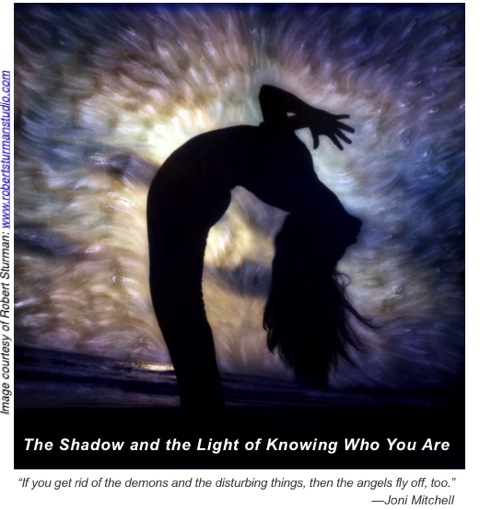
The subtitle of the book is The
Shadow and the Light of Knowing Who You
Are. It means
that if we are really serious about exploring
consciousness we must be willing to work with our own
shadow and light. Everyone has a
“Shadow”—those negative aspects of
ourselves (our fears, guilt, shame, anger) that we have
pushed down into our unconscious from early childhood.
But whatever we suppress remains in us and we either
project it onto others or it erupts in some kind of
mind-body illness.
And we not only suppress our “miserable”
selves, we also suppress our “magnificent”
selves—those parts of us that are creative,
powerful, compassionate, and loving. To really know who
we are, and to grow as healthy spiritual beings, we
need to embrace both our Shadow and our Light. As Joni
Mitchell said: “If you get
rid of the demons and the disturbing things, then the
angels fly off, too.”
We
need to embrace our inner “zombies” as well
as our inner “angels.” And so:
Consciousness
from Zombies to Angels. It’s a
“user’s guide” to the mind from
“Z” to “A.” To make the most
effective use of this guide, we need to use our four
gifts of knowing.
Q:
What are the ‘Four Gifts of
Knowing’?
CdeQ:
Each of us
has many different
ways of knowing, with the
potential to be a philosopher, a scientist, a shaman,
and a mystic. It all depends on where we focus
attention and what gifts we decide to cultivate.
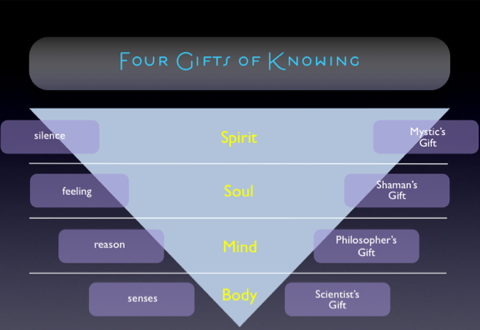
The
Scientist’s Gift is
our senses—and
a method
for testing our
assumptions and beliefs through the power of
rigorous observation;
we use this
gift to explore the world of matter, including our
bodies.
The
Philosopher’s Gift is
reason
and
language;
we use this gift to explore the realm of mind.
The
Shaman’s Gift is
feeling
and
alternative
states of consciousness; we use this
to explore the domain of soul.
The
Mystic’s Gift is
intuition
and
sacred
silence; we use this
to unite with the essence of spirit.
If
we wish to truly understand consciousness, we need to
cultivate and integrate all our “gifts of
knowing.” It’s not enough to just study the
brain using the Scientist’s Gift (though that is
valuable, too). And using just the Philosopher’s
Gift of reason, logic, and language gives us only
intellectual knowledge about
the mind
(also useful if we want to talk or write about
consciousness). However, it cannot bring us to the
heart of consciousness itself which is
experience.
For that, we need to also cultivate deep awareness
of feeling
and
intuition
(the
Shaman’s and Mystic’s Gifts).
We need these last two gifts to develop and evolve
consciousness. No amount of information about how the
brain works or intellectual knowledge of the mind will
ever lead us to transformation.
We need to
be willing to be open to the full spectrum of
consciousness—including our shadow and light, our
inner zombies and angels. And to do so effectively, we
need to engage in some form of psycho-spiritual
practice.
It seems to me that the essence and aim of all
spiritual practice is to help us cultivate what I call
“experience
beyond belief.”
Q:
What do you mean by ‘experience beyond
belief’?
CdeQ:
These days,
it’s quite common to hear people say, “you
create your own reality” or “reality is
whatever you believe.” The idea is that we can
create or change the world simply by changing what we
think or believe.
That seems to me to be a big mistake. Yes, indeed,
consciousness does play a role in shaping the physical
world. But be careful. The truth is not so
simple—or as simplistic—as the popular
cliché would have us believe. It is based on a
confusion between “belief” and
“intention.” Beliefs are mental habits that
block our creative power. Intentions, however, are
creative and have power to change lives. They are
purposeful, focused expressions of consciousness
through choice.
Beliefs, on the other hand, are frozen fragments of
consciousness, static snapshots of reality. It works
like this: first, at every moment, we are having
an experience.
Then,
we interpret
our
experience using thoughts (words and ideas). But every
thought is an abstraction,
literally
plucked from the ongoing stream of experience. Next, we
solidify our thoughts by turning them into
beliefs.
We assume that what we think is true (that’s a
definition of “belief” ). But we
don’t stop there. We often go a step further and
turn our beliefs into dogma
by
believing
our beliefs. We insist
that our beliefs equal reality (that’s the
definition of dogma).
The problem is we then act
based on
what we believe. But, as everyone knows, a belief can
be right or wrong. For example, some people believe
that God exists, some people don’t. Who’s
right? They can’t all be right, because those
beliefs cancel each other out. And if beliefs really
did create reality, then here’s what would
happen: When people believe in God, God would exist,
and when people don’t believe, God would not
exist. So, God would be popping in and out of existence
on the whims of what human beings believed. What a
strange Supreme Being that would be!
It’s important to remember that
any
belief can
be right or wrong (it may more or less accurately match
reality or it may totally miss the mark).
However, an experience
can never be
wrong. Every experience always is exactly
what it is. You can
never have a “mistaken” experience. You can
be mistaken only about your interpretation (thought or
belief) of your experience.
Therefore, since beliefs run the risk of being wrong,
and experience is never wrong, it makes far more sense
to pay attention to your experience than to act on your
beliefs. I’m saying that the goal of every
spiritual practice is to eliminate the “middle
man” of interpretation and belief, and to
act
directly from experience.
Here’s what typically happens:
experience —> interpretation —>
belief —> dogma —> action
By contrast,
when we cultivate “experience beyond
belief” we become like martial artists, great
athletes, or creative artists who act
in the
moment based on
what they actually experience.
Have you
ever noticed that consciousness or experience always
happens right
now. And, have
you noticed when reality happens? Like experience,
reality also happens right
now. That’s
very convenient. It means that our experience connects
us directly with reality.
However, our
thoughts and beliefs always distort reality in some
way. They remove us from
the in-the-moment
experience
where we connect directly with what
is. That’s
why I encourage us to cultivate experience
beyond belief. And to learn
to act directly from experience:
experience —> action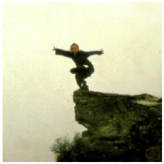
Q:
Are you saying we should give up all our
beliefs’?
CdeQ:
Not at all.
We can’t help having beliefs (it’s what our
minds have evolved to do, and they do that job very
well). But we can choose whether or not to be attached
to our beliefs. We can choose whether or not we
believe
our beliefs
to be true. I’m encouraging us not to believe our
beliefs. Rather, I suggest that we learn to notice
them, and then release them, let them go.
Wisdom resides in our moment-to-moment experience, not
in our beliefs. As habits of mind, beliefs are
conditioned by the past. Experience, on the other hand,
always occurs in the present
moment—now.
Of course, I don’t want you to believe what
I’m saying, either. I do, however, want you to
listen with an open mind, and to allow yourself
to feel
and
experience
whatever
comes up for you as you respond to the meaning of my
words. Pay
attention to what you are
feeling—to
the sensations rippling through your body. That’s
the source of your wisdom. Not your abstract thoughts.
As long as we have bodies, we will have ego-minds, and
as long as we have ego-minds we will have beliefs. We
don’t have much, if any, choice about that. But
we do have a choice whether or not to
believe
our beliefs.
I often remind students of Plato’s final words.
On his deathbed, the great philosopher gathered his
followers around him and told them that everything he
had taught and written was nothing more than a
“likely story.”
That’s how we should hold our
beliefs—lightly, as “likely stories.”
Q: You talk about going beyond ‘physics
envy.’ What do you mean?
CdeQ:
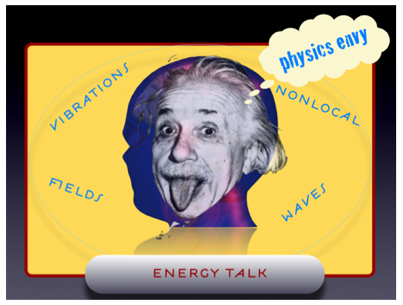
Many people
use “energy talk” to describe consciousness
or spirit. They use words such as “energy,”
“vibrations,” “frequency,”
“resonance,” “waves,”
“fields,” “mechanism,” and a
current favorite, “nonlocal.” All of these
words are borrowed from physics. They describe what
goes on in the physical
world.
But mind or
consciousness is not part of the physical world. It
is non-physical.
In my work,
and particularly in Consciousness
from Zombies to Angels, I encourage
people to “watch their language” when
talking about consciousness. I point out that using
“energy talk” misses the most important
point about consciousness—namely it is
subjective.
Everything
in physics, and all the terms borrowed from physics,
refer to objects,
to things in
the objective world.
Consciousness is not an object, it is not objective. It
is the subject
of experience. It is
awareness
and
choice.
It cannot be
detected by physical senses or instruments, and cannot
be measured. Therefore, it makes no sense to use the
language of physics to describe what cannot be
physically measured.
Nevertheless, people tend to cling to “energy
talk”—because, paradoxically, they think it
makes what they say sound more “scientific”
or more “grounded.” Actually, the opposite
is true. The language of physics is the language of
abstractions. If we want to be truly
“grounded” then we should ground what we
say in what we actually experience—and use
“mind talk” instead of “energy
talk.” We should not confuse the
experiencer
(consciousness)
with what is experienced (energy).
Frequently, when I make this point, someone says:
“But if we give up energy talk then we would have
to invent a new language.” This surprises me. I
point out that, in fact, we already have a very rich
vocabulary for talking about consciousness—words
such as “intention,”
“attention,” “purpose,”
“meaning,” “perceiving,”
“observing,” “remembering,”
“wanting,” “anticipating,”
“believing,” “doubting,”
“affirming,” “denying,”
“imagining,” “judging,”
“understanding,” “feeling,”
“experience,” “choice” . . .
and on and on. None of these words can be reduced to
“energy talk” or be explained by physics.
Consciousness
has its own very appropriate language.
I’m
suggesting that if we want to push beyond the final
frontier, then we will make much better progress if we
“watch our language” and use “mind
talk” instead of “energy talk.”
Q:
Your book has four parts. Can you summarize the key
points?
CdeQ:
In
Part 1, we begin
with the Philosopher’s Gift to explore:
What is
consciousness? I focus on
the three core problems in philosophy of mind:
(1)
Mind-body connection:
How are mind
and body related—does the brain produce mind, or
does consciousness create the brain; do they exist in
parallel universes or does consciousness “go all
the way down”?
(2)
Other minds: How can we
tell if anyone else has consciousness—or even if
rocks can feel anything?
(3)
Free will:
Do we really
have choice, or is everything determined by God, by
genes, or by physics?
In
Part 2, we then
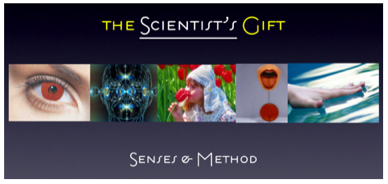
shift to the Scientist’s Gift to explore:
How the
brain works and
how
consciousness is related to quantum
physics.
We enter the curious wonderland of the quantum to see
how its strange inhabitants may give us insights into
the origins and nature of consciousness. If you ever
wondered what a quantum is, what
“nonlocality” really means, or why quantum
physics might be relevant to consciousness, you will
find easy-to-grasp keys to this fascinating domain.
I also show why recent advances in neuroscience and
brain imaging that claim to “photograph
God” are highly misleading. Yes, it is useful to
know what goes on in the brain when someone is having a
mystical experience, but no scientific instruments can
probe or capture what goes on in an experience.
Information
about the brain is not the same as information about
consciousness. Brain is not mind, and brain science is
not consciousness science.
For that, we need a very different kind of science,
with a very different approach. Instead of standard
Plate-Glass science, which separates subject from
object, we need a new “Looking-Glass”
science, where there is no separation. In true
consciousness science, the mind is exploring itself.
And once we turn the beam of inquiry back on
itself—when awareness is focused on
itself—we must be open to whatever bubbles up in
consciousness. We must be willing to engage with our
Shadow, with all the fears, and shame, and anger hiding
out in our unconscious mind. In short, a consciousness
scientist must be willing to undergo
psycho-spiritual transformation.
Only when we open up to our inner “zombies”
and “angels,” can we move forward on the
path to enlightenment.
Then, in
Part 3, we focus on
the Shaman’s Gift and Mystic’s Gift and
explore: Why
consciousness is important. We learn how
our minds fall into different patterns, or grooves of
thought, and how to shift out of the habits that keep
us stuck.
We learn how to recognize “strange
attractors” that pull our minds this way and
that. We learn how the ego is formed, how it grows into
our personality, and becomes embodied. We also learn
how to transcend these restrictions through creative
acts of choice and letting go to realize our full
potential.
Besides learning to recognize our patterns, the
Mystic’s Gift takes us into the realm of scared
silence, rooted in experience beyond belief. It helps
us to accept all of
who we are—our
ego, our personality, our shadow, our light, our
zombies and angels. We discover what it means to
“Know Thyself” by following the seven steps
to knowing who you really are.
Finally, in
Part 4, we shift
to “Consciousness in Dialogue.” One of the
greatest satisfactions of being an author, teacher, and
public speaker is the feedback I get from people who
have read my books, attended a talk, heard me on the
radio, seen me on TV, visited my website, or taken one
of my classes. I get a lot of emails, and, thankfully,
I’m often challenged to defend or clarify
something I’ve written or said. It keeps me on my
toes. Sometimes a real gem of a question whizzes
through cyberspace and gets me thinking deeper and more
carefully about an idea I’ve put out there.
I’ve collected these “gems” over the
years, and have created an archive of
“MindBytes”—a series of questions and
answers organized under headings such as
“God,” “Energy,”
“Cosmos,” “Evolution,”
“Miracles,” “Quantum,”
“Time,” “Beliefs,” and, of
course, “Consciousness.” These are
“learning nuggets” that highlight important
questions, and I include examples at the end of each
chapter. Part 4 of the book is composed of longer
dialogues on topics such as “experience beyond
belief,” “consciousness, energy, and
evolution,” “are rocks conscious?”
and “is consciousness the same as spirit?”
Q:
What are the seven steps to knowing who we really are?
CdeQ:
Watch
Your Language
Pay
attention to the words you use when talking about
consciousness.
Be precise.
Get beyond “physics envy.” Use “mind
talk” not “energy talk.”
Identify
the Problem
What do you
want to know about consciousness?
1. Mind-body
problem: How are
body and mind related?
2.
Problem
of other minds: How do you
know whether anyone else has consciousness, or
what’s going on in others’ minds?
3.
Problem
of free-will: Do your
really have a choice or is everything determined by
physics or by god?
Learn How to Look
How do you
explore consciousness? Learn the difference between our
Four Gifts of Knowing—Scientist’s Gift
of senses;
Philosopher’s
gift of reason;
Shaman’s
gift of feeling;
and
Mystic’s Gift of intuition
and
sacred
silence. Learn why
understanding the brain is not the same as knowing your
mind.
Recognize
Your Patterns
How do you
organize your thoughts and beliefs? An attractor is a
tendency of a system to fall into a recurring pattern.
We all have unconscious habits of mind and patterns of
behavior that drive us. What attractors or patterns
drive you?
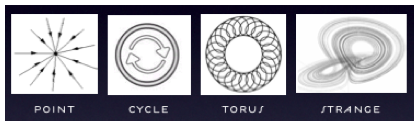
Consciousness is a complex
system that shapes itself around four major types of
“attractors”— point
(ego),
cycle
(personality),
torus
(new
possibilities), and strange
(creative
self-expression).
Point
attractor—kicks
in when you are fixated or obsessed with something.
When used to focus attention, it can be positive. It is
the way of the
ego.
Cycle
attractor—jumping
from one fixation or addiction to another, oscillating
between competing desires. When the cycle attractor
kicks in, we move back and forth between attraction and
aversion, between positive and negative. It is the way
of
personality.
Torus
attractor—a way
out of the repetitiveness of ego and personality
habits. Instead of cycling back and forth between
pleasure and pain, we “break the spell” and
spiral into new possibilities. It is the way of
embodied imagination.
Strange
attractor—combines
order and chaos, creativity and stability. Opens us up
to choice and creativity. It is the way of
self-expression.
Transformation is a whole-system shift that
involves all
attractors—the
ego point, the personality cycle, the embodied torus,
and the strange Self.
Know
Thyself
The keystone
of every spiritual philosophy—from Socrates to
Buddha—is the question: Who are
you—really? Are you your
ego, your personality, your body, or your soul? Do your
have a core self? Are you an avocado or an artichoke?
Can you get beyond your ego? What happens if you let go
of your cherished beliefs?
Embrace
Your Shadow
Only by
accepting and integrating all
of who you
are, can you truly know who you are and step on the
path to transformation.
From early childhood, we have all suppressed fear,
shame, guilt, and anger. We have stuffed
“negative” experiences down, out of
consciousness. But these demons never went away. They
live in us, in our bodies and minds, as our
“shadow” self—our “inner
zombies.”
We have done the same with our “light,”
too. Along with our miserable selves, we have blocked
off our magnificent selves. We often fear our greatness
and are ashamed of our power. We suppress our
“inner angels,” too.
Transformation
happens only when we acknowledge and embrace our full
humanity—our Zombie shadow and Angel light.
Practice
Transformation
Transformation
is not a one-time event. It is a lifelong process that
requires cultivating consciousness at every moment, in
every circumstance. It’s a never-ending dance
between ego and spirit, between Shadow and Self,
between Zombie and Angel.
All seven
steps to knowing who you are can be summed up in a
single phrase: experience
beyond belief. And this
last step itself involves its own seven
steps—reflecting the fractal nature of
transformation.
Q:
What are the seven steps to transformation?
CdeQ:
Step
1: Accept that beliefs are natural.
We all have
beliefs. There’s no getting away from that.
It’s a simple fact of life. It’s natural to
have beliefs—it’s what our minds are for.
They evolved to give us maps or shortcuts that help us
navigate through life. Just don’t mistake your
beliefs for reality. The map is not the territory. You
don’t drive your car onto the map and you
don’t eat the menu. Yes, beliefs are natural,
nevertheless they disconnect us from reality.
Step
2: Realize that every belief is a habit of
mind.
Thoughts and
beliefs are abstractions—literally
“snapshots” of reality taken from the
ongoing flow of experience as it happens moment by
moment. They are frozen fragments of consciousness,
mechanical habits that keep you stuck in the past.
Mesmerized by your beliefs, real life flows past
unnoticed. Here’s how it works: You have
an experience.
Then you interpret
it. Turn it
into a belief.
Then
into dogma.
Beliefs, then, are nothing but mental habits, stepping
stones to dogmatism and fundamentalism.
Step 3: Recognize the origin of
beliefs.
Every belief
is composed of thoughts, and every thought begins as a
feeling. Think about it: Long before you could think or
speak, as an infant your life was flushed with
feelings.
Feelings
come first. They are grounded in your body and connect
you with reality.
Step 4: Focus on feelings in the
body.
Feelings are
literally the sensations you experience in your body.
Learn to pay attention to them. Take time out to sit
quietly and just notice what’s going on, without
trying to change anything. Simply feel your
sensations—in your chest, around your eyes, in
your legs, your back, your belly . . . Remember: Every
thought begins as a feeling, and feelings connect us
with the world. They are messages from nature. Learn
what it means to feel
your thinking—and
not just think your thoughts.
Step 5: Stop believing your beliefs.
“But,”
you say, “if I don’t have any beliefs,
I’ll have nothing.” Far from it. In fact,
letting go of beliefs opens you up to
what is
really happening in your experience—right
now! And
experience is the royal road to reality. Have you
noticed: Experience and reality always happen
together, right
now. Also, notice
I didn’t say “stop having beliefs.”
That would contradict Step 1. As long as you have a
mind, you can’t help having beliefs. It’s
what the mind does naturally, and you have little
choice about that. But you do have a choice whether or
not you believe
your
beliefs. You do not have to believe that your beliefs
are true.
Instead, you
can learn to hold beliefs as “likely
stories,” as Plato once said. So, take courage,
let go of your beliefs, don’t hold onto them, and
see what happens. I promise: You won’t disappear,
you won’t die.
Step 6: Cultivate being the Witness.
As you
practice sitting quietly, feeling the sensations in
your body, noticing thoughts as they come and go,
arising from your feelings, you will come to a new
realization about who you are. You are
not your mind. You are not your thoughts or
beliefs. In fact, you
are not even your feelings. In this evolving state of
consciousness, you will begin to experience a new sense
of freedom. You may begin to notice something quite
profound: someone,
or some other part of you, is observing everything that
is going on. The question
is: Who?
That’s
the sixty-four-billion dollar spiritual jackpot.
It’s the essence of spiritual practice. Who,
then, is observing the flow of thoughts
through your
mind? Well, that’s
who you are!
You are the Witness that unifies self and world. And
the way to get to this realization is by practicing
experience beyond belief.
Step 7: Spend more time in ‘sacred
silence.’
In the end,
the core wisdom of all spiritual traditions is some
form of “Let go and let God.” Learn to
just be—by
yourself or in community. Be comfortable beyond
thoughts, words, judgments, or beliefs. You don’t
need to sit still and quiet to practice this, but it
helps. It takes some discipline to tame the mind, to
wean it off its diet of beliefs, to break the habits of
thoughts, desires, and fears that inevitably distract
us and distort reality. After a while, though, when you
pay more attention to the Witness, you come to realize
that the deepest source of wisdom is not what you think
or believe. Rather wisdom lies in that space of
“sacred silence” beyond all words and
ideas, where what
is shines
forth. Those who open up to it, often call it the
Source.
Christian de Quincey, Ph.D.,
is Professor of Philosophy and Consciousness Studies at
John F. Kennedy University; Dean of Consciousness
Studies at the University of Philosophical Research;
and Director of the Center for Interspecies Research.
He is also founder of The Wisdom Academy, offering
private mentorships in consciousness; and cofounder of
The Visionary Edge, committed to transforming global
consciousness by transforming mass media. Dr. de
Quincey is author of the award-winning book
Radical
Nature: Rediscovering the Soul of
Matter
and Radical
Knowing: Understanding Consciousness through
Relationship.
His latest
books are Consciousness
from Zombies to Angels and
Deep
Spirit. Samples of
his writings on consciousness and cosmology are
available at www.deepspirit.com.